


Performance management is a process that starts in an organization right from the moment of hiring an employee. The employees have to be closely watched to see the alignment of their behavior and work with the organization’s goal. Each organization has its own way of deciding the parameters that form the factors for employee appraisals.
 Looking for Performance Management Software? Check out SoftwareSuggest’s list of the Best Performance Management Software Solutions.
But most of the time, employees agree that their performance has not been weighed as per what they have worked. Hence it is necessary to have a process to manage the performance of employees which keeps them motivated to work in a better way.
Performance management goes beyond just annual appraisals. It involves the process of planning the employee’s goals and reviewing their performance on a regular basis.
Below we have listed out the performance management process that can serve as an ultimate guide for your organization,
Important Steps for the Performance Management Process
1. Setting Goals
The setting of goals takes place at three different levels.
First, the management has to decide the long-term and short-term goals for the organization.
The management then has to decide a goal at the department level. This should be in line with the organization’s goal.
The third and final goal setting is for the employees. In this, the management sets targets for individuals as per their role in the system as a whole and sees in the appraisal cycle if the goals are met.
- Checking the job profile of the employees and verifying this against their current scope of work.
- Checking whether the work is in line with the goals of the company and if the tasks are fulfilled by the employee.
- Preparing a work plan for the employees, highlighting the deliverables expected from them, and making it clear the basis on which their performance will be evaluated.
- Making a list of the training or certification that can be helpful to the employees in upgrading their skills and performing better and providing training for the same later on.
- Preparing a career objective for the employees that fit in the long-term career plan.
Setting the right goals in the performance management process can be quite tricky as there are certain things that the employees might be doing on a regular basis that might not be considered significant enough but it matters anyway. Hence, the goals must be set holistically, covering all the tasks that are performed by the employees.
The goals set by the organization to gauge the performance must be:
- The work to be done by the employees needs to be specified clearly along with a plausible time interval to complete it and the degree to which it has to be completed by individuals.
- The work done by the employees should be measurable in terms of the criticality of the task, the amount of work done, its quality, and the time it took to do it.
- The management must assign only such tasks that are actually workable and reasonable to achieve to check the output of employees.
- The goals assigned must be in line with the organization’s goal as the main aim of the performance management process as a whole is a common goal for the uplifting of the organization.
- A time frame should be allotted to complete the goals defined for the employees. In most cases, it is the end of the employee review cycle.
2. Setting a Standard for Goal Achievement
Goals define the tasks to be performed by the employees to get appraisals and promotions. The next step in the performance management process is revealing the standard procedure which will outline how these goals are to be achieved.
Meeting the defined standards helps in evaluating the performance of employees. The following parameters are used to define how a task assigned should be achieved:
Quality of Work
The management should check if the task done by the employee meets the standards of deliverables expected as per their scope of work. Whether the work done is accurate and effective to improve the output of the organization or not. It is also necessary to check whether the final result is up to the desired standards or not.
The Quantity of Work
The quantity of work delivered by the employee must be a deciding factor in reviewing performance. Not only this but the error occurrence per task assigned must be checked to gauge the accuracy and thus the resultant output.
Timeframe
The deadlines set by the organization must not be too easy or too difficult to turn around with the assigned task.
Other tasks
If the employee has done a certain task that has resulted in the progress of the organization voluntarily without it being a part of the defined objectives, this must be considered too. An example can be completing the assigned work before the timeline or optimizing the project for effective outputs.
3. Monitoring and Feedback
Monitoring the work of employees doesn’t mean that the manager has to keep a close look at what they are doing every day. What matters is the final result.
The management must also see if the employees are working in a comprehensive progressive environment, aiding their fellow mates and thus the organization as a whole for a positive outcome.
This must also be included in the matrix that will form the basis for calculating the performance of an individual. The management must also ensure that the employees have the resources and training necessary to achieve the goals set for them.
When it comes to providing feedback, the following should be done by the management;
- Check the progress done by the employees toward achieving the objectives set for them.
- Check if anything in the existing performance management system is hindering the progress towards those goals and what can be done to tackle that.
- If there is any change in the goals of an organization, the same must be reflected in the objectives set for the individuals so as to keep things up to par.
- Honest feedback must be given on the work of employees and this includes constructive suggestions to improve work too.
4. Reviewing Performance
The Review phase forms an important part of the performance management process as the employees get to know how they have evolved over time.
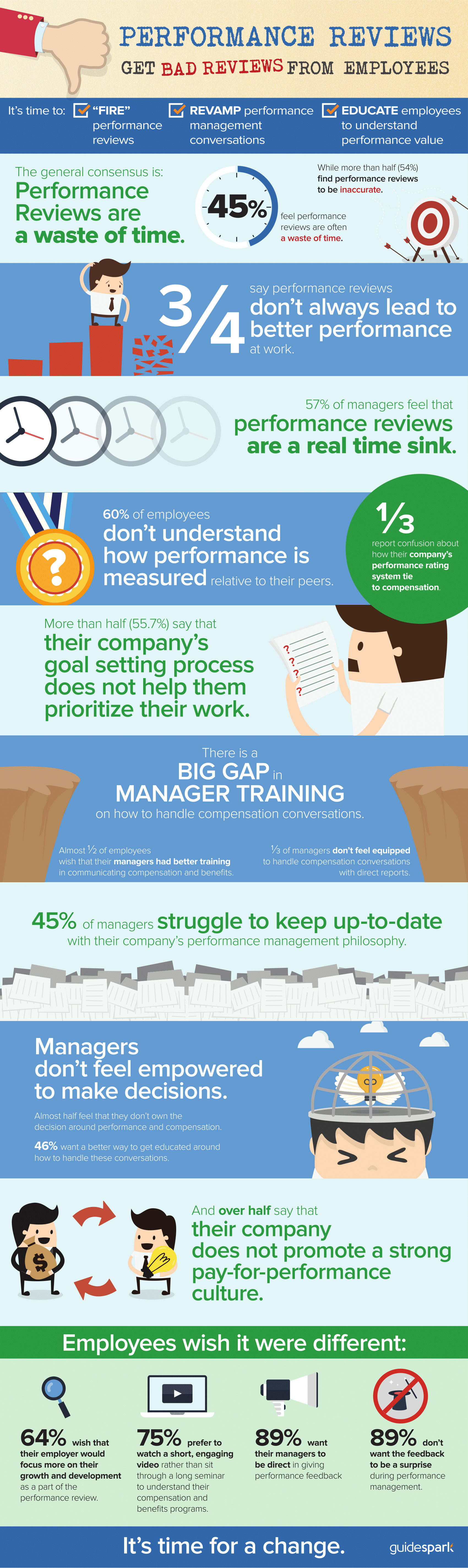
How does today’s corporate workforce perceive the performance management process? Source: Guidespark
In most organizations, there is something called self-assessment in which the employees review their own performance against the set checklist before the official meeting for review by the management.
This process is to fill the gap between what the employees think of their work and what the management perceives and this can be further discussed in the performance review meeting.
The following becomes a part of the management while carrying out this phase;
- The work done since the beginning of the appraisal cycle has to be noted, it must be matched with the objectives set for the individuals and the results must be compared keeping in mind the achievements and failures throughout.
- Things that have become a hindrance to carrying out the defined goals must be noted and the possible steps to be taken or training that can be organized to mitigate these challenges.
- Know the various factors that have affected the performance of the employee directly or indirectly.
5. Final Evaluation
At the end of the day, employees expect a good return for their work and a just evaluation of their performance.
This process becomes difficult because the employees might think otherwise. This can make or break an organization’s system.
While evaluating the performance, the management should do the following;
- Give a crystal clear explanation for the rating provided.
- Must keep the past achievements in mind.
- Shouldn’t be biased based on various social parameters like age, gender, race, or disabilities.
- Make sure that the employees know the aspects based on which work evaluation takes place.
- Reforming the goals to suit the organization and then forming an evaluation report with documentation.
- A professional and respectful environment is a must as this can affect the behavior of the employees.
Conclusion
Appraisals form the basis for any organization and making it work the right way is the goal for all of them. A good performance management process serves as a motivation for the employees. This, in turn, results in the growth of an organization. Make sure your organization follows the correct method for employee appraisals.

A digital marketing and content curator at SoftwareSuggest, a software recommendation platform. I am passionate about Digital Marketing, and all things digital. Also interested in technology and innovation. In my spare time, enjoy playing cricket, and Badminton.


