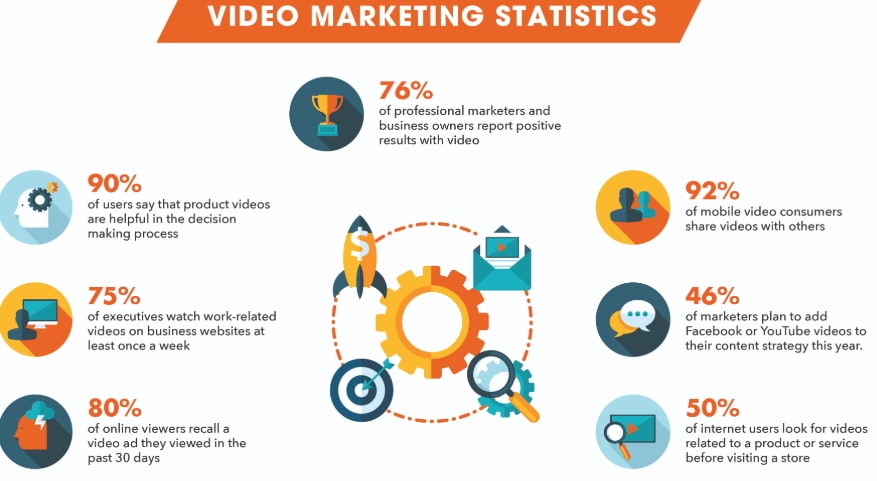
The video marketing industry is becoming more and more competitive with increasing market trends.
More and more companies are creating effective video marketing strategies as a result of growing customer demands, more competition, and a need to stay current with trends.
With the sudden rise of digital platforms and the demand for visual content, a study by Wyzowl found that 91% of marketers now use video as a marketing tool to increase their relevancy.
Looking for a Digital Marketing Company? Check out SoftwareSuggest’s list of the Leading digital marketing companies.
But the question still remains, which tactic works the best? Read more and know which strategies work for your business.

Incorporate a mix of content types in your video marketing strategy, including educational video, testimonials, and promotional videos, to keep your audience engaged and informed.
What is Video Marketing?
Video marketing refers to the use of video content to promote or market a brand, product, or service.
It includes a variety of video formats, including social media snippets, how to videos, product demos, brand videos, educational videos, and customer testimonials. Video marketing serves as an effective medium for conveying complex messages in a simple, engaging format that resonates with viewers.
From YouTube ads to Instagram stories, video marketing spans across multiple platforms, offering businesses opportunities to increase their reach and engage different demographics.
The growing trend of video consumption online has made it necessary for brands to include video in their marketing mix.
Top 10 Video Marketing Strategies
Even though you will receive a ton of advice about video marketing from strangers, most of it might not be useful for you. However, here are some of the proven video marketing tactics that will work for your business.

Source: filmora
1. Repurpose Your Video Content
Repurposing video content is a cost-effective strategy that maximizes your investment in video production. By transforming one piece of content into various formats, you can reach a wider range of audience without starting from scratch.
“For instance, a long-form webinar can be edited into bite-sized clips for social media, or a detailed explainer video can be broken down into short tutorials.”
Repurposing also allows you to tailor content to fit different platforms and audience preferences. A single video can be adapted into a blog post, an infographic, or even a podcast, ensuring your message gets across on multiple channels.
Additionally, repurposing old content into new formats helps extend its lifespan, keeping it relevant for longer periods.
By optimizing your existing video content, you not only save time and resources but also increase your chances of reaching different audience segments.
You May Also Check: 20 Best Video Marketing Software
2. Incorporate User-Generated Content (UGC)
Customers are getting tired of watching the same amateur videos that brands generate. Instead, people want to watch videos that have an honest and sympathetic vibe.
User-generated content (UGC) is a powerful way to build trust and authenticity in your brand. By encouraging your audience to create and share their videos related to your product or service, you create a sense of community while gaining valuable content for your marketing efforts.
Content from users or unpaid contributors has a greater chance of being trusted and connected with customers than content from the brand itself. UGC videos can be utilized in a number of ways, such as:
- Using them in your sponsored marketing campaigns.
- Putting them on your landing pages or website.
- Including them in your marketing campaigns via email.
- Sharing them on social media.
However, for you to add user-generated content (UGC) films to your video content marketing strategy, you must first have customers creating videos about your company. If your collection of user-generated content videos isn’t very large, you can:
- Run a hashtag contest.
- Personally reach out to your loyal customers.
- Send your customers an affectionate message.
You May Also Check: 17 Best User Generated Content Platform
3. Focus on Vertical Video Production
With the rise of mobile consumption, vertical video has become increasingly popular, especially on platforms like Instagram, TikTok, and Snapchat. Vertical videos offer a more immersive experience for mobile users, as they fill the screen without the need to rotate the device.
In fact, 78% use social media platforms on their mobile devices, making vertical video a must-have in any modern video strategy.
Brands that embrace vertical video can capitalize on this trend by creating content tailored specifically for mobile audiences. Whether it’s short-form videos for Instagram Stories or engaging clips for TikTok, vertical videos help brands reach viewers in a format that feels natural and user-friendly.
Moreover, vertical video content is highly shareable, allowing for greater organic reach and engagement. By optimizing your video production for vertical formats, you ensure that your content remains relevant in an increasingly mobile-centric digital landscape.
4. Personalize Your Video Content
Video is more effective than other content formats because it allows you to emotionally connect with your audience. However, the emotional component of videos these days is often missing, as several brands are only interested in pushing their products and services in front of their target audience.
In an era where consumers are bombarded with generic ads, personalized video marketing stands out by addressing the specific needs and interests of your audience.
: Personalized video emails can feature a customer’s name or recommend products based on their past purchases. These individualized touches make the content feel more relatable, increasing the likelihood of conversion.
This strategy not only increases engagement but also builds loyalty by making your customers feel valued and understood.
5. Collaborate with Influencers
Influencer marketing has gained significant popularity in recent years, and video content is one of the most effective ways to leverage influencers’ reach.
Collaborating with influencers allows brands to tap into their established audiences, creating authentic and relatable content that resonates with viewers.
When choosing influencers, it’s important to select those who align perfectly with your brand values and target audience. Let’s see which things to consider before hiring an influencer:
| Things To Consider Before Hiring an Influencer | |
|---|---|
| |
| |
| |
| |
| |
| |
|
By partnering with influencers, you not only expand your reach but also improve your brand’s credibility. Viewers are more likely to trust recommendations from people they follow and admire, making influencer collaborations a powerful video marketing tactic.
6. Showcase Video Testimonials on Your Website
One of the most effective types of content you can provide on your website is video testimonials. They provide potential customers with first-hand accounts of how your product or service has positively impacted others.
This social proof can be incredibly compelling, as viewers are more likely to trust the experiences of real customers over traditional marketing messages.
Featuring video testimonials on landing pages, product pages, or even in email campaigns can significantly improve your conversion rates. These videos should be authentic, showcasing real customers sharing their stories in their own words.
“Professional production quality isn’t always necessary—what matters most is the sincerity and relatability of the testimonial.”
By strategically placing video testimonials on your website, you create an emotional connection with your audience, making them more likely to trust your brand and take the desired action.
7. Create Engaging Animated Videos
Animated videos offer a creative way to present complex information in a visually engaging and easily adaptable format. They are especially effective for explaining intricate concepts, such as product features or services that might be difficult to convey through live-action videos.
Animation allows you to simplify abstract ideas and present them compellingly and entertainingly. Brands can use animated explainer videos to guide their audience through processes, demonstrate the benefits of a product, or introduce a new concept.

Additionally, engaging animations can capture viewers’ attention quickly and hold them longer, making it a powerful tool in your video content marketing strategy.
Whether you’re educating your audience or telling a brand story, animation provides endless possibilities for creativity and engagement.
8. Utilize Live Streaming for Real-Time Engagement
Live streaming has become a powerful way to engage with your audience in real-time, offering a sense of immediacy and authenticity that pre-recorded content can’t match.
Through direct communication with their audience, brands can create a sense of community and involvement through platforms such as Facebook Live, YouTube Live, and Instagram Live.
Live streaming is ideal for:
- Product launches
- Q&A sessions
- Behind-the-scenes looks
- Special events
The real-time nature of live streaming encourages spontaneous interactions, making the experience more personal and engaging for viewers.
Another major benefit of live streaming is the opportunity to receive instant feedback from your audience. This allows you to address questions or concerns on the spot, creating a two-way conversation that builds trust and transparency.
You May Also Check: 20 Best Live Streaming Software
9. Integrate Video Ads into Your Marketing Strategy
Video ads are a powerful way to reach your target audience across various digital platforms, from YouTube to social media channels like Facebook and Instagram. These ads can be highly targeted, allowing you to reach specific demographics based on interests, behaviors, and online activities.
The key to effective video ads is creating content that captures attention quickly, as viewers often have the option to skip ads after just a few seconds. Optimizing your video ads for different platforms ensures that they resonate with each audience segment.
“For instance, shorter, more engaging ads work well on social media, while longer, more detailed ads may be better suited for YouTube.”
By adapting video ads into your overall marketing strategy, you can increase your brand’s visibility and reach a wider audience.
10. Use Video in Email Marketing Campaigns
Video content can significantly improve the effectiveness of your email marketing campaigns.
Whether you’re promoting a new product, sharing customer testimonial videos, or offering behind-the-scenes content, video adds a dynamic element that grabs attention and encourages interaction.
When implementing video into your email campaigns, it’s important to optimize for different clients and services.
Embed a thumbnail or GIF of the video with a clear call-to-action that directs recipients to the full video. This approach can improve user engagement and lead to higher conversions.
Including the word "video" in the subject line alone can increase open rates by up to 19%. Source : StartMotionMedia
How to Create a Video Marketing Strategy?
Strategies for video marketing are not new. Now that we’ve given video marketing tips let us understand completely how to create a digital video strategy.

1. Start with Clear Video Goals
Before diving into video production, it’s important to define clear goals for your video marketing strategy. Whether your objective is to increase brand awareness, generate leads, or drive sales, having specific goals will guide your video creation process and help measure success.

(i). Define Your Purpose
Every video should have a clear purpose. Whether you are aiming to increase brand awareness, educate your audience, drive traffic, or convert leads into customers? By defining your primary goal, you set the direction for the content, messaging, and tone of your video. For example, an explanation video will have a different approach than a video ad aimed at conversions.
(ii). Set Measurable Objectives
Once you know your purpose, set measurable objectives to track success. Establish KPIs (Key Performance Indicators) such as video views, engagement rates (likes, shares, comments), or conversion rates.
(iii). Align Video Goals with Overall Marketing Strategy
If your overall goal is to increase customer engagement, your video must focus on storytelling and creating emotional connections with viewers. If driving traffic is the prime focus, consider creating teaser videos that lead viewers to your website or landing pages.
(iv). Prioritize and Plan for Scalability
Start with high-priority goals, but consider how your video strategies can scale. For example, you might prioritize brand awareness initially, but as your strategy grows, you can shift toward generating leads and conversions.
You May Also Check: 20 Best Video Management Software
2. Identify Your Target Audience
Understanding your target audience is important for creating video content that resonates with them. Start by researching your audience’s demographics, interests, and behaviors. Knowing who your audience is will help you tailor your content to meet their preferences and needs.
Creating a persona for your buyer is necessary. If you already have one, then you are on the right track. A company often creates one or more buyer personas during the process of creating its offer for products or services.
Once you’ve created your buyer’s profile, you’ll be able to identify your target market with precision. Just make sure your video marketing assets have considered the following before finalizing your audience strategy:
- For whom is your product or service for?
- What is the purpose of your video?
- What is your target audience’s taste or preference?
Once you have the answers to these three questions, you’ll know who your target audience is and how to get in touch with them.
For example, if your audience consists of young adults, platforms like TikTok and Instagram might be more effective for your video marketing efforts.
3. Develop a Compelling Story
A compelling story is the heart of any effective video marketing strategy. Your story should be engaging, relatable, and aligned with your brand message. There are 4 elements for creating a compelling storyline:
(i). Strong Opening Hook
The first few seconds of your video are very important. A strong opening hook grabs the viewer’s attention immediately and entices them to keep watching. This could be an intriguing question, a bold statement, a captivating visual, or an emotional moment.
(ii). Clear and Relatable Narrative
A great video has a clear and relatable narrative that resonates with the audience. The story should follow a logical flow, with a beginning, middle, and end. Relatable characters, real-life scenarios, and emotional appeals can help forge a deeper connection with viewers.
(iii). Emotionally Engaging Content
Emotion is a powerful tool in storytelling. Whether it’s humour, inspiration, empathy, or excitement, emotionally engaging content makes your video memorable and helps build a strong bond with your audience. Use visuals, music, and voice over services to evoke the desired emotions, making your story more impactful and shareable.
(iv). Clear Call-to-Action (CTA)
A compelling story should guide viewers toward a specific action at the end of the video. Whether it’s subscribing to a channel, visiting a website, or making a purchase, a clear and concise CTA tells your audience what you want them to do next.
These storytelling elements must lead the audience on a journey that is consistent with your brand’s objective.

4. Align with Creative Requirements
Once you’ve developed a compelling story, it’s time to align it with your creative requirements. This includes determining the style, tone, and visual elements that will bring your story to life.
Whether you’re using live-action, animation, or a combination of both, ensure that your creative choices reflect your brand identity and resonate with your audience.
It’s essential to collaborate with your creative team—whether in-house or outsourced—to ensure everyone is aligned with the vision. Factors such as lighting, colour schemes, music, and voiceover should all contribute to delivering a cohesive and engaging final product.
By aligning your story with creative requirements, you’ll create a video that not only looks good but also effectively communicates your message.
You May Also Check: 20 Best Video Editing Software
5. Follow Your Production Schedule
Video production can be a complex process that involves multiple stages, from pre-production and filming to post-production and editing. To ensure everything runs smoothly, it’s mandatory to create and stick to a production schedule.
Here are important points to consider when developing and following your production schedule:
(i). Break Down the Production Process
The production process can be divided into three main phases:
| 3 Phases Of Production Process | ||
|---|---|---|
| Pre-production | Production | Post-production |
|
|
|
(ii). Assign Clear Deadlines for Each Stage
Establish deadlines for each phase of the video production process. This includes setting specific dates for script finalization, filming, editing, and review. Assigning clear deadlines helps keep the project on track and ensures that your video is completed on time.
(iii). Coordinate Resources and Talent
Your production schedule should take into account the availability of all resources, including crew, equipment, and talent. Coordinating everyone’s schedules can be challenging, so plan and confirm availability to avoid any disruptions.
(iv) Prioritize Post-Production Time
Post-production is often underestimated in terms of the time and effort required. Editing, sound design, colour correction, and adding visual effects can take longer than expected. Ensure that sufficient time is allocated for post-production tasks in your schedule.
6. Stick to a Realistic Budget
Creating high-quality videos can be expensive, but it’s important to stick to a realistic budget to ensure your video marketing strategy remains cost-effective.
Start by determining your budget for each stage of the production process, including pre-production, production, and post-production.
Consider factors like talent, editing, location, equipment, and talent. To make sure that the right people see your videos, you also need to budget for distribution and promotion.
By managing your budget carefully, you can produce high-quality content without overspending.
: When creating a video marketing strategy, companies must be cautious about unexpected expenses that can arise during the production process.
7. Optimize for Distribution and Promotion
Creating a great video is only half the battle; distributing and promoting it effectively is just as important. Once your video is ready, it’s time to optimize it for distribution across various platforms.
Each platform has its unique requirements, so ensure your video is formatted correctly for each channel—whether it’s YouTube, Instagram, Facebook, LinkedIn, or your website.
Additionally, it’s also necessary to market your film across various platforms, including paid advertising, email marketing, and social media platforms.
Use relevant keywords and tags to improve searchability and encourage sharing. You can use top SEO software and tools, which will help your video rank on Google.
By optimizing your distribution strategy, you can ensure your video reaches a wider audience and achieves its intended goals.
8. Measure and Analyze Performance
It’s important to track and evaluate results in order to determine the success of your video marketing campaign. Use analytics tools to track key metrics such as views, engagement, conversion rates, and ROI.
By analyzing these metrics, you can obtain important insights into what is working and what requires improvement.
“For instance, if you notice high engagement on certain platforms but low conversions, you may need to tweak your call-to-action or landing page.”
Thus, by regularly measuring and analyzing performance, you can refine your video marketing strategy and achieve better results over time.
You May Also Check: 25 Best Video Analytics Software
9. Stay Updated with Trends
The world of video marketing is constantly developing, with new trends and technologies emerging regularly. In order to stay one step ahead of the competition, you need to walk with the latest trends in the market.
This could include new platforms, video formats, or content styles that resonate with your target audience.
“For example, trends like short-form videos, interactive videos, and virtual reality (VR) content are gaining popularity among consumers.”
By following the latest trends, you can keep your content interesting and relevant while bringing new ideas to your video marketing plan.
Wrapping Up
With the ability to interact and engage their audience more effectively, video marketing has become an integral component in today’s marketing strategies for firms.
You can increase traffic, improve conversions, and strengthen your brand’s presence by implementing video marketing best practices and adhering to a well-defined plan for creating and sharing video content.
As you embark on your video marketing journey, remember to stay adaptable, measure your success, and continuously refine your approach based on data and emerging trends. With the right strategy in place, video marketing can become a powerful tool for achieving your business goals.
A video marketing strategy is a plan that outlines how a business will use video content to achieve specific marketing goals. It includes defining target audiences, creating compelling content, distributing videos on the right platforms, and analyzing performance to optimize results.
To use video marketing for lead generation, create videos that address your audience’s pain points, offer valuable insights, and include strong calls to action. Use landing pages, email marketing, and social media marketing platforms to distribute your videos and track leads through forms or gated content.
The key elements of a successful video marketing strategy include setting clear goals, understanding your target audience, creating engaging content, optimizing for distribution, measuring performance, and staying updated with trends.
The best video marketing strategy for social media involves creating short, attention-grabbing videos that are optimized for mobile viewing. Focus on engaging content like stories, live streams, and user-generated videos to connect with your audience in real-time.

Upgrade your business operations with modern software solutions tailored to your needs.